Short, structured, assessment-ready activities that connect to the OB, leadership, and HRM concepts on your syllabus. No special software, no course redesign.
Built to drop into a standard course schedule. Hover any card for the detail.
60–90 minutes, self-paced. Fits before a tutorial, between lectures, or as an assignment.
Instructor guides, debrief slides, reflection prompts, rubrics, and concept maps, all ready to use.
Structured prompts and grading rubrics make it simple to mark the simulation as coursework.
Concept maps connect every in-game choice to the models and constructs you already teach.
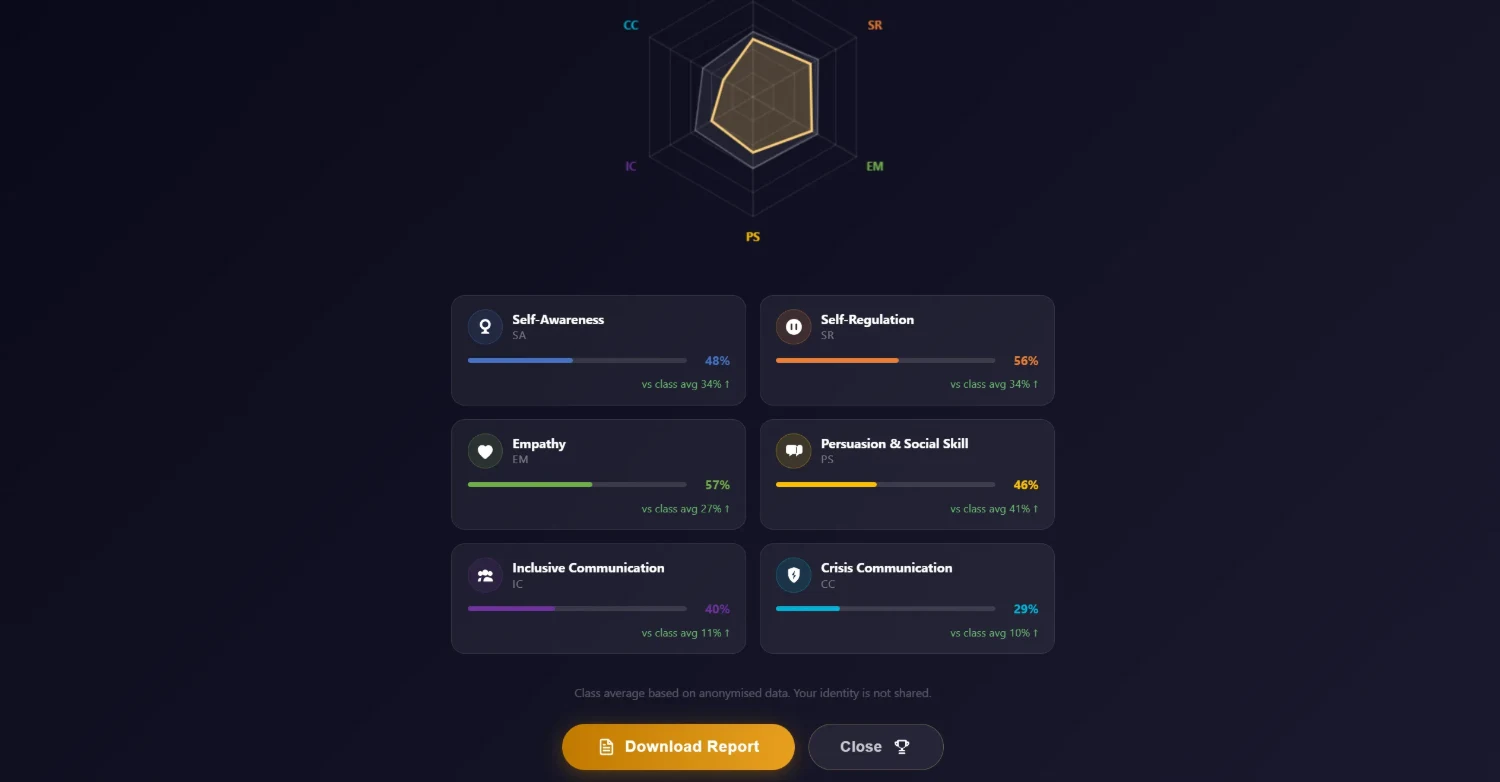
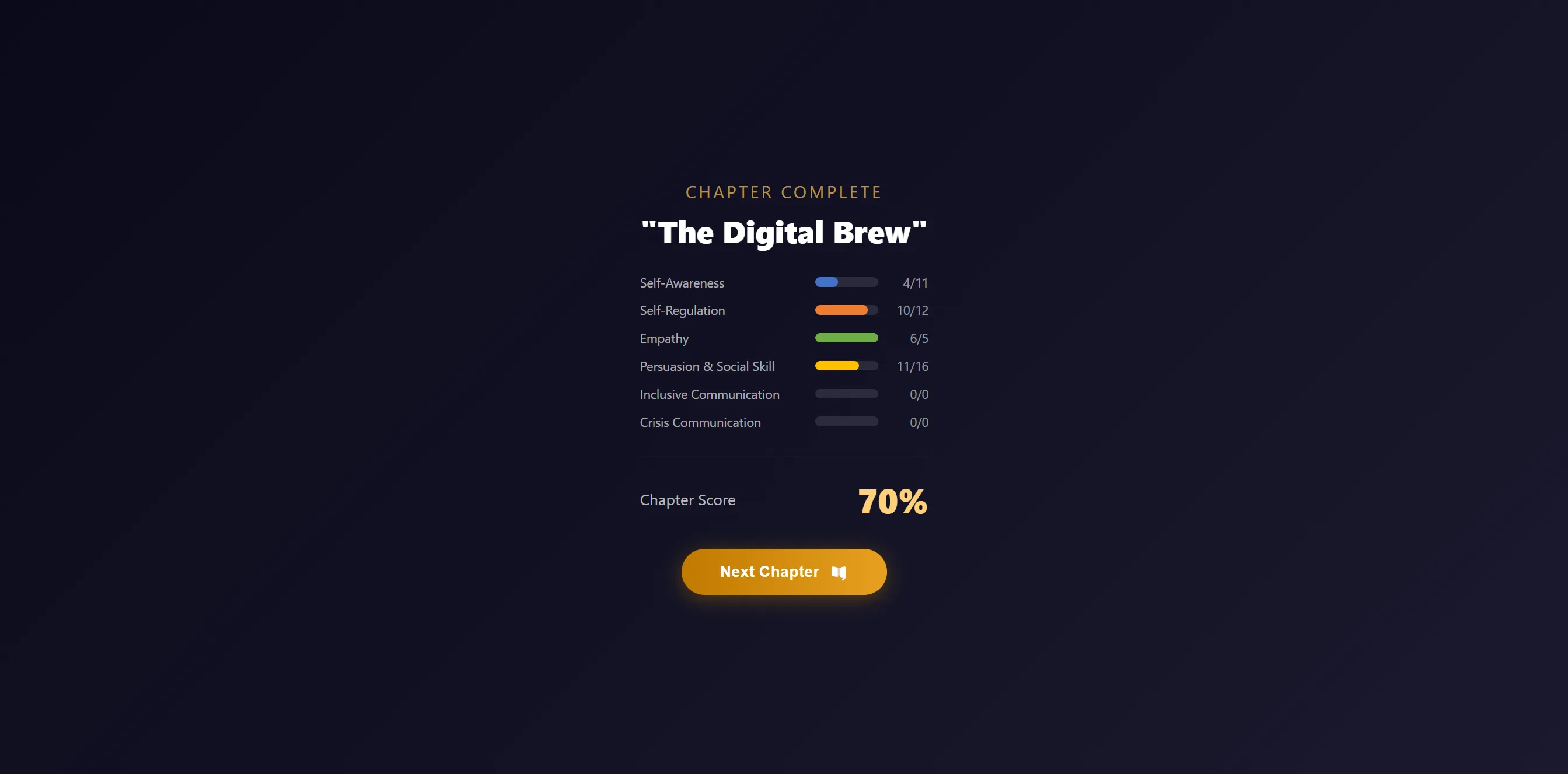
Aggregate cohort data and individual reports: perfect fuel for a rich debrief.
Students join online with a single access code. No downloads, no accounts, no LMS integration.
Tap a step to see what happens.
Share a single access code by email or LMS. Students play the simulation self-paced, in 60–90 minutes, before they walk into class, with no setup on your end.
Takes 60–90 minutesAcross six chapters they face realistic workplace dilemmas. Every decision shifts outcomes and scores so that the consequences feel real.
Six branching chaptersStructured prompts, from basic recall to critical application, connect each choice to course theory. Use them graded or ungraded, with the rubrics provided.
Prompts & rubrics includedWalk the cohort through key decision points with ready-made slides and class-level analytics, surfacing how different approaches led to different outcomes.
Slides + analyticsAssign the simulation as pre-class homework, then use the class period for a structured debrief: comparing decision patterns, surfacing different leadership approaches, and connecting back to theory.
Run the simulation live in a tutorial or computer lab. Students play individually, then discuss their choices in small groups before a facilitator-led debrief.
Set the simulation with reflection questions as a graded individual assignment. Students submit reflections linking their gameplay choices to OB or leadership concepts, marked with the included rubric.
Use near the end of a course to pull together the semester, asking students to identify the OB, leadership, and HRM concepts embedded in a single simulation.
Frame the simulation as a lived example of evidence-based management, asking students whether their choices were grounded in research evidence, and what the alternatives were.
Pick one to see how HumanSide maps onto it.
Leadership, motivation, attitudes, team dynamics, communication, psychological safety, OCB and CWB, all embedded in the way these simulations are designed and scored.
Every decision in the simulation is, at heart, a leadership-communication choice, making these an ideal fit for leadership courses at any level.
Recruitment, performance, harassment, burnout, and engagement sit at the centre of upcoming simulations, and of most HRM course outlines.
A simulation built specifically to teach evidence-based decision-making as a core management practice, weighing research evidence against instinct under pressure.
Short, intensive, and reflective: ideal for MBA modules and executive programmes that need applied, discussion-generating activities inside tight timeframes.
Employee wellbeing, harassment, and psychological safety (topics increasingly central to OB and HRM programmes) anchor two upcoming simulations.
Educator time is finite. Everything you need to assign, run, and assess ships with the game, so you can focus on the discussion, not the prep.
Step-by-step facilitation notes: how to assign it, what to expect, common student reactions, and how to run the debrief across different class formats.
A ready-to-use deck walking through key decision points, class data, and links to course concepts, designed to spark discussion, not deliver answers.
Reflection questions aligned to the learning outcomes, written at multiple depths, from recall to critical application, to suit a range of assignment formats.
Assessment criteria with descriptors at multiple performance levels, easily adapted to your institution's grading conventions.
Visual maps linking each gameplay dimension to specific theories and course topics, making alignment with your outcomes easy to demonstrate.
Individual developmental reports and class-level aggregate data to spot patterns, inform debriefs, and understand how your cohort decided.
Educator pilots are free. Student access codes are priced to be realistic for course adoption.
University instructors and trainers get full access to any available simulation, at no cost, to evaluate it for their course.
Students purchase their own access code directly on the Simulations page.
Request a free educator pilot, ask a question about course fit, or book a demo to see a simulation in action.